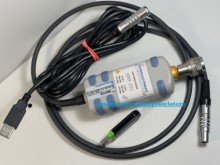
Rohde Schwarz NRP-Z91 Average Power Sensor
The Rohde Schwarz NRP-Z91 is a diode based average power sensor that measures average RF power from 9 kHz to 6 GHz. It is designed for very wide frequency coverage including the bands relevant to terrestrial radio communication as well as the lower frequency bands down to 9 kHz. With very low measurement uncertainty excellent matching, and low sensitivity to harmonics it is a good, precise choice for EMC, calibration, and general RF power work. It uses Rohde & Schwarz Smart Sensor technology so it can be operated directly from a PC with no separate power meter base unit.
Key Features
- Wide frequency range: 9 kHz to 6 GHz
- Wide power range: about -67 dBm to +23 dBm (roughly 200 pW to 200 mW)
- Very large dynamic range: around 90 dB for both CW and modulated signals
- Average (continuous) power measurement: accurate readings on modulated signals as well as continuous waves
- Very low measurement uncertainty: with excellent matching (low SWR) and low sensitivity to harmonics
- Designed with EMC applications in mind: suited to EMC test setups, including use with the RadiMation software
- Operable on a PC without a base unit: a USB connection through the NRP-Z3 or NRP-Z4 USB adapters with R&S NRPV or NRP Toolkit software or with an R&S NRP/NRP2 power meter base unit
- Smart sensor design: the sensor holds its own calibration data and processing with fast response and several averaging filter modes
- Connector: Type N (male) input
- Compact and rugged: easy to place close to the device under test
Typical Applications
- EMC test setups and radiated or conducted immunity testing
- Signal generator and amplifier output power verification
- Calibration lab and production test power measurements
- General RF and wireless power measurement from low frequencies up to 6 GHz
- Use in automated test systems controlled by a PC
Why Choose It
The Rohde Schwarz NRP-Z91 gives engineers an accurate flexible power sensor that covers both the low frequency and the radio communication bands in one device. Using it with just a PC and USB adapter keeps the cost and bench footprint low.