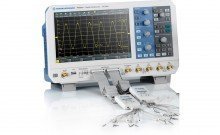
Rohde Schwarz RTB2K-COM2 Oscilloscope Package
The Rohde Schwarz RTB2K-COM2 is a complete oscilloscope package built around the two channel R&S RTB2002 with a 300 MHz bandwidth and the mixed signal (MSO) option plus the RTB PK1 application bundle. It is aimed at embedded design education, and manufacturing test and it brings a scope logic analyzer, protocol analyzer waveform and pattern generator, and digital voltmeter into one bench instrument. R&S sells the larger four channel sibling the RTB2K-COM4 as a similar package.
What’s Included
- R&S RTB2002 oscilloscope: 2 analog channels with a 300 MHz bandwidth (the upgraded version) a 10-bit A/D converter and 10 Mpts of memory per channel
- Mixed-signal option: 16 digital channels (the “MSO” version) for debugging analog and digital signals together
- RTB-PK1 application bundle: a package of options that adds serial protocol analysis, signal generation and extended memory features
- Protocol analyzer and triggers: serial triggering and decoding for I²C, SPI, UART/RS-232/RS-422/RS-485, CAN, and LIN with decoding of up to two serial buses from analog or digital channels at once
- Arbitrary function generator and bit pattern generator: built in for creating test signals without a separate generator
- History and segmented memory option: extends memory to 160 Msample so you can scroll through past acquisitions and analyze them with all of the scope tools including protocol decode and logic channels
- Frequency response analysis (Bode plot): included in the package option list
- Standard instrument features: a 10.1-inch capacitive touchscreen, a digital voltmeter, frequency counter, mask testing, FFT, zoom, and search
Typical Applications
- Embedded systems design and debugging
- Serial bus analysis (I²C, SPI, UART, CAN, LIN)
- Education labs and training
- Production and service testing
- Mixed signal debugging with logic channels and protocol decode
Why Choose It
The Rohde Schwarz RTB2K-COM2 package bundles the most commonly wanted options with a capable two channel scope so a lab can start with serial decoding, a signal generator, and logic channels already in place instead of buying each separately.